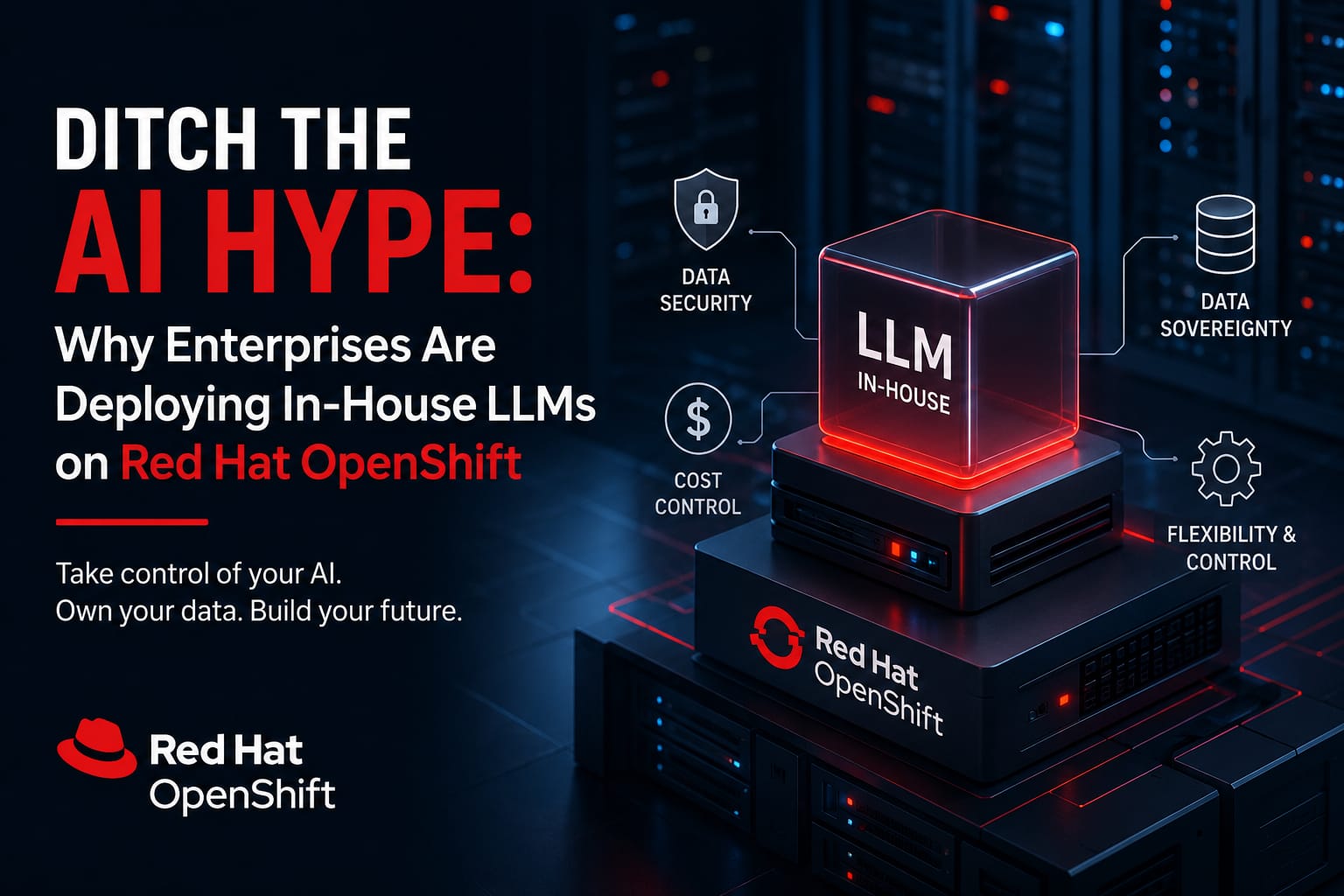
Ditch the AI Hype: Why Enterprises Are Deploying In-House LLMs on Red Hat OpenShift in 2026
Ditch the AI Hype: Why Enterprises Are Deploying In-House LLMs on Red Hat OpenShift Instead of Trusting the Cloud
There is a familiar pattern playing out in enterprise IT right now. A new AI platform launches with bold promises, a polished demo, and a freemium tier designed to create dependency. Teams plug in. Usage grows. The invoice arrives. And somewhere around month four, the CTO asks a question nobody thought to ask at the start: who actually owns this intelligence layer?
The honest answer, in most cases, is the vendor does. Your data trained their model. Your queries improved their system. Your teams built workflows on top of an API that can change price, change behavior, or disappear entirely with 90 days notice.
The enterprises that are winning at AI in 2024 are not the ones with the biggest cloud AI bill. They are the ones that made a different decision early: deploy an in-house Large Language Model on Red Hat OpenShift, keep data sovereign, control costs, and build AI capability as a genuine organizational asset rather than a rented utility.
This post breaks down why that decision makes sense, how Red Hat OpenShift makes it practical, and what the path to a production-ready private LLM actually looks like.
The Uncomfortable Truth Behind AI-as-a-Service Hype
Cloud AI APIs are not neutral tools. They are products built to maximize platform stickiness. The onboarding is smooth by design. The switching costs grow invisibly until they are enormous. And the business model depends on you never asking too hard about what happens to the data you send.
Here is what the vendor pitch decks consistently underemphasize:
Cost Scaling Is Not Linear
Token-based pricing looks reasonable in a proof of concept. It does not look reasonable when your internal chatbot is handling 50,000 queries a day or your document processing pipeline is ingesting thousands of contracts a week. Production-scale AI API usage routinely runs into five or six figures monthly. That bill grows every time your business grows — which is the opposite of how infrastructure costs should behave.
Data Privacy Is a Structural Problem, Not a Settings Toggle
When you call a third-party LLM API with your business data, that data crosses your security perimeter. Depending on your vendor agreement, it may be used to improve the model, stored in logs, or subject to legal requests in jurisdictions outside your control. For organizations in finance, healthcare, legal services, or government, this is not a theoretical risk. It is a compliance violation waiting to happen.
Model Changes Break Your Workflows
OpenAI deprecated GPT-3.5 Turbo with limited notice. Vendors regularly shift model behavior through silent updates. The prompt that worked perfectly in January produces different output in July. When you do not control the model, you do not control the stability of any system built on top of it. For enterprise production environments, that unpredictability is unacceptable.
What In-House LLM Deployment Actually Means
An in-house LLM is a large language model that your organization hosts and operates on infrastructure you control — whether that is on-premises servers, a private cloud, or a hybrid environment. You own the weights. You manage the updates. You decide who can query it and what data it can access.
This is not the same as building a model from scratch. The open-source AI ecosystem has matured to the point where production-ready models are freely available, well-documented, and actively maintained by large research communities. What you are deploying is proven technology — you are simply choosing where it runs.
The practical benefits are immediate and compound over time:
- Your sensitive business data never leaves your controlled environment.
- Inference costs become fixed infrastructure expenses, not variable per-query fees.
- You can fine-tune the model on your proprietary datasets to improve domain accuracy.
- Version pinning means no surprise behavior changes in production.
- Compliance audits are simpler because the entire stack is within your governance boundary.
Why Red Hat OpenShift Is the Right Platform for Private AI
Kubernetes is the foundation for containerized AI workloads. But raw Kubernetes demands significant platform engineering investment before it is production-ready. Red Hat OpenShift is enterprise Kubernetes — pre-hardened, pre-integrated, and designed to run mission-critical workloads from day one. For LLM deployment specifically, OpenShift brings capabilities that matter enormously in practice.
GPU Workload Management Without Custom Engineering
LLM inference requires GPU acceleration. OpenShift integrates natively with the NVIDIA GPU Operator and Node Feature Discovery (NFD), which automatically detects GPU hardware and makes it available to pods as a schedulable resource. You do not need to write custom device plugins or manage driver compatibility manually. OpenShift handles it, and your inference servers get the hardware they need with standard Kubernetes resource requests.
Red Hat OpenShift AI: A Complete MLOps Platform
Red Hat OpenShift AI (RHOAI) is a purpose-built MLOps layer that ships on top of OpenShift. It combines JupyterHub for interactive model experimentation, KServe for production model serving, Kubeflow Pipelines for automated training and evaluation workflows, and a Model Registry for version management. Your data scientists and platform engineers work from the same integrated toolchain — no stitching together disparate open-source components with custom glue code.
Security That Satisfies Compliance and Security Teams
OpenShift ships with Security Context Constraints that enforce least-privilege container execution by default. Role-based access control is granular and auditable. Network policies isolate workloads at the namespace level. FIPS 140-2 compliant cryptography is supported out of the box. For regulated industries — healthcare, finance, government, defense — these are not nice-to-haves. They are table stakes, and OpenShift delivers them without custom configuration.
Hybrid Cloud Flexibility
OpenShift runs consistently across AWS, Azure, GCP, VMware, and bare metal on-premises infrastructure. Your LLM workload runs wherever your data and compliance requirements dictate — not wherever a vendor decided to locate their data center. As your requirements evolve, the platform travels with you without re-architecture.
The Open-Source Model Landscape Is Production-Ready
One of the most persistent myths in enterprise AI is that you need a frontier commercial model to do serious work. The open-source model ecosystem in 2024 has effectively closed that gap for the majority of enterprise use cases.
Meta LLaMA 3 70B delivers GPT-4 class performance on reasoning and instruction-following benchmarks. Mistral Large competes directly with Claude 3 Sonnet on most business tasks. IBM Granite models are specifically designed for enterprise deployments with strong performance on code, text, and structured data tasks, and come with commercial-use licensing clarity. Qwen 2.5 72B is competitive with the best commercial options on multilingual and technical workloads.
For specialized domains — legal, medical, financial, engineering — smaller models fine-tuned on domain-specific data routinely outperform large generic commercial models. And fine-tuning is only possible when you control the model. That is a capability moat that grows over time as your training data accumulates.
Serving these models on OpenShift is straightforward using vLLM, which exposes an OpenAI-compatible REST API. Your developers call the internal endpoint using the same SDKs and patterns they already use. The migration from an external API to an internal one is a configuration change, not a re-architecture.
Real Enterprise Use Cases Running on Private OpenShift LLMs Today
Private LLM deployments on Red Hat OpenShift are not whiteboard exercises. They are production systems delivering measurable value across industries right now.
Financial Services
Banks and insurance firms use private LLMs to analyze contracts, generate regulatory reports, summarize earnings calls, and power internal compliance assistants — all without exposing client financial data to external APIs. One mid-size European bank reported a 60% reduction in compliance documentation time after deploying a fine-tuned LLaMA model on OpenShift.
Healthcare
Hospital systems deploy in-house LLMs for clinical note summarization, ICD-10 coding assistance, and patient query triage. Because the model runs inside the hospital’s own infrastructure, HIPAA compliance is maintained without complex data processing agreements with AI vendors.
Government and Defense
Federal agencies run air-gapped OpenShift clusters hosting LLMs for document classification, intelligence analysis summarization, and policy drafting. Data residency requirements are met by design, not by contractual assurance.
Manufacturing
Industrial manufacturers connect private LLMs to their ERP and PLM systems, generating maintenance documentation, analyzing equipment fault codes, and producing supply chain risk summaries automatically. The model understands internal part numbers, supplier codes, and production vocabulary because it has been fine-tuned on internal data.
Getting Started: A Realistic Path to Your First Private LLM on OpenShift
A production MVP does not require a multi-year transformation programme. With the right approach, you can have a working in-house LLM serving internal users within four to six weeks. Here is the pragmatic path:
Start with a use case, not a model
Pick one high-value internal task — contract review, internal knowledge Q&A, code assistance, customer query classification. This focus drives all subsequent decisions about model size, hardware, and data.
Choose your model based on task and hardware
For a single A100 80GB GPU, LLaMA 3 8B or a quantized 70B model covers most use cases. For two GPUs, unquantized 70B gives excellent results. IBM Granite is worth evaluating if enterprise licensing clarity is important.
Deploy OpenShift with GPU nodes
Provision OpenShift on your preferred infrastructure. Add GPU-enabled worker nodes and install the NVIDIA GPU Operator via OperatorHub. This process is well-documented and takes a few hours, not days.
Install Red Hat OpenShift AI and configure KServe
Enable RHOAI from OperatorHub, configure model storage using MinIO or ODF, and deploy your first ServingRuntime using vLLM. Your internal OpenAI-compatible API endpoint is live.
Connect your first application
Point your internal chatbot, document tool, or developer copilot at the internal endpoint. Measure latency, throughput, and output quality against your baseline.
Iterate and expand
Add RAG pipelines using PGVector or Milvus for retrieval-augmented generation. Begin collecting domain-specific fine-tuning data. Expand to additional use cases as the platform matures.
The Decision That Separates AI Leaders From AI Dependents
The AI vendor ecosystem is not going to get less crowded or less aggressive in its sales approach. The hype will continue. The demos will keep looking impressive. And the lock-in will keep deepening for organizations that do not ask the foundational question: do we want to own this capability or rent it indefinitely?
Red Hat OpenShift gives you the enterprise-grade Kubernetes platform to run AI workloads reliably and securely. Open-source LLMs give you models capable of handling real business tasks without commercial licensing constraints. The combination gives you something no cloud AI vendor will ever sell you: genuine ownership of your organization’s intelligence layer.
The technology is not experimental. The models are not second-rate. The platform is battle-tested across thousands of enterprise deployments worldwide. What is stopping you from owning your AI is not capability — it is the habit of defaulting to the vendor path because it feels easier in the short term.
Run a focused four-week proof of concept on OpenShift. Deploy a model. Connect one real use case. Measure the results. That single experiment tends to change the conversation permanently — because the gap between what you assumed and what you discover is usually the gap between vendor marketing and engineering reality.