
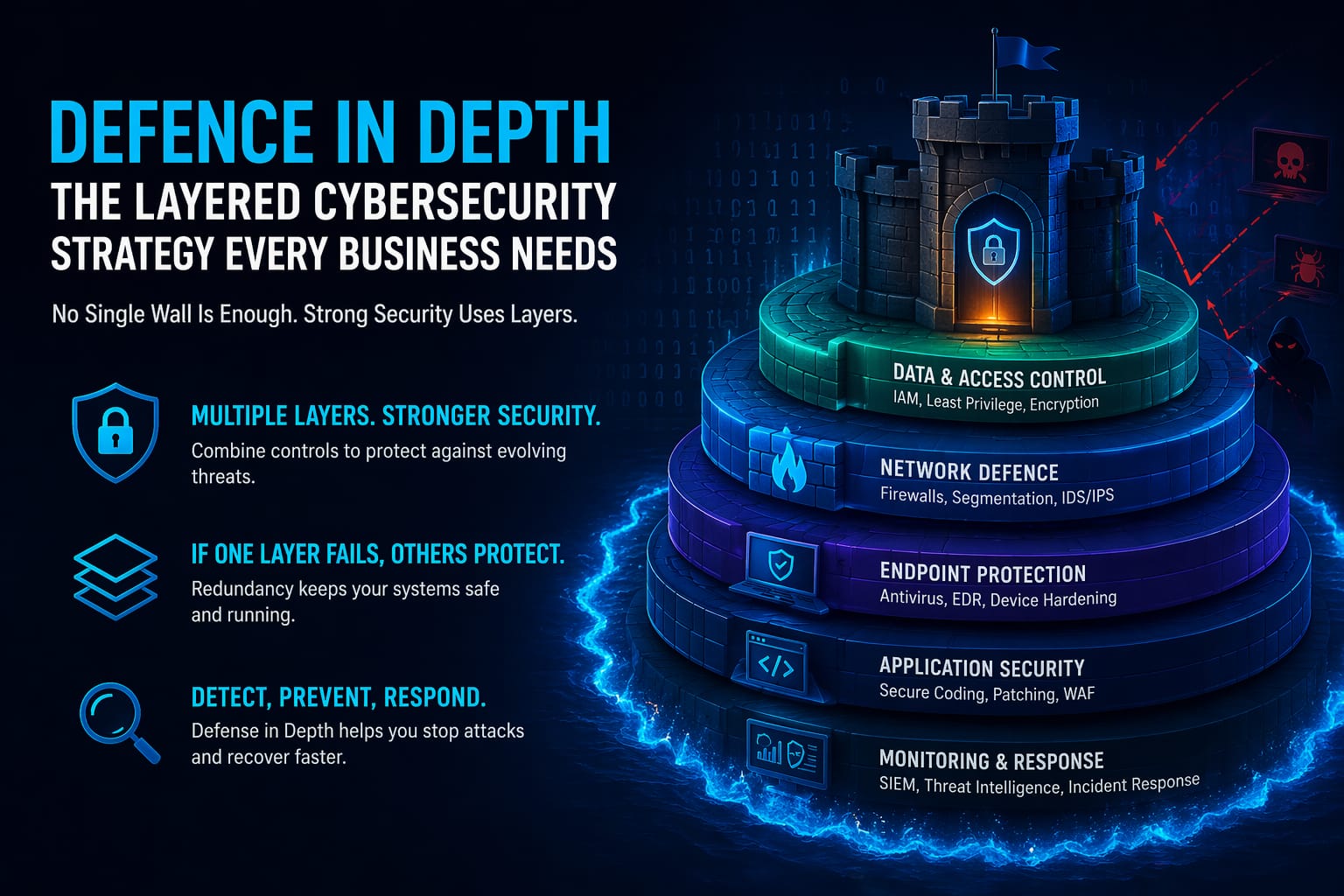
Defence in Depth: The Layered Cybersecurity Strategy Every Business Needs
Think of a medieval castle. It does not rely on just one thick wall to keep invaders out. It uses a moat, a drawbridge, an outer wall, guards, and a fortified keep — each one a separate barrier. If attackers break through one layer, another is already waiting.
That is the idea behind Defence in Depth (DiD) — one of the most important strategies in modern cybersecurity. Instead of betting everything on a single firewall or antivirus tool, DiD spreads protection across multiple independent layers. When one layer fails, the others keep working.
What Is Defence in Depth?
Defence in Depth is a cybersecurity approach that uses multiple overlapping security controls to protect your systems, networks, and data. No single control is expected to be perfect — the strength comes from the combination. Originally a military concept, it was adapted for information security to address a simple truth: attackers only need to succeed once, while defenders need to succeed every time. Layering controls shifts that balance back in favour of the defender.
The core principles are straightforward:
- No single point of failure — if one tool is bypassed, another catches the threat
- Diverse controls — different tools catch different attack types
- Least-privilege access — users can only reach what they genuinely need
- Continuous monitoring — threats are caught early, before major damage is done
The 3 Types of Security Controls
Every DiD strategy is built on three categories of controls that work together:
Physical Controls
These protect the hardware and facilities your systems run on — data centre access cards, biometric scanners, CCTV, and locked server racks. No amount of software security matters if an attacker can physically walk up to your servers.
Administrative Controls
These are the policies, procedures, and training that govern how people interact with technology. Role-based access control, incident response plans, and security awareness training all fall here. Human error causes most breaches — administrative controls directly tackle that.
Technical Controls
Firewalls, antivirus, encryption, intrusion detection systems — these are the software and hardware tools that actively block or detect cyber threats. Most cybersecurity budgets focus here, but technical controls alone are never enough.
The 7 Layers of Defence in Depth
A full DiD model is typically visualised as rings, with your most sensitive data at the centre. Each ring is a security layer:
- Physical Security — restricts who can physically access your infrastructure, including data centres, server rooms, and workstations
- Identity and Access — verifies who is trying to access your systems using multi-factor authentication (MFA), single sign-on (SSO), and role-based access controls
- Perimeter Security — firewalls and IDS/IPS filter traffic entering and leaving your network, and defend against DDoS attacks that aim to overwhelm your systems
- Network Security — segments your internal network so that even if an attacker gets inside, they cannot move freely between systems
- Compute Security — hardens the operating systems, virtual machines, and servers running your workloads through patching, configuration management, and host-based controls
- Application Security — secure coding practices, Web Application Firewalls (WAFs), and regular penetration testing protect apps from SQL injection, XSS, and similar attacks
- Data Security — encryption at rest and in transit, plus data loss prevention (DLP) tools, ensure that even stolen data cannot be read or misused
A Real Example: Stopping Ransomware with DiD
Here is how Defence in Depth stops a ransomware attack in practice. An employee receives a phishing email with a malicious attachment and opens it.
- Email security flags it as suspicious — but the user opens it anyway
- Endpoint security detects the unusual process and quarantines the file before it executes
- If it spreads, network segmentation prevents it from reaching critical servers
- Even if data is exfiltrated, encryption makes it completely unreadable to the attacker
At no point did the entire defence depend on one tool working perfectly. That is exactly the point of Defence in Depth — resilience through layers.
How to Start Building Your DiD Strategy
You do not need a large budget or an enterprise IT team to begin. Follow these practical steps:
- Run a risk assessment — identify your most critical assets and the most likely threats to them
- Audit your current controls — where are you strong? Where are the gaps?
- Layer, don’t just upgrade — adding a second moderate tool often beats upgrading one tool to ‘the best’
- Train your people — run phishing simulations and make security a regular topic, not a one-off event
- Monitor continuously — use a SIEM to collect and correlate logs from all your layers
- Test regularly — penetration testing reveals how your layers actually perform under attack
Final Thoughts
Defence in Depth is not a product you buy — it is a mindset. It accepts that no single security control is perfect and builds resilience by stacking imperfect controls together. When one layer fails, another holds. In a world where cyberattacks are growing in frequency and sophistication, relying on a single line of defence is a risk no organisation can afford. Whether you are protecting a small business or a large enterprise, the answer is the same: layer your defences, train your people, and never stop testing.