Zero Trust Cybersecurity in 2026: Navigating the Future of Secure Access
Introduction
In an increasingly complex digital landscape, traditional perimeter-based security models are no longer sufficient. The rise of remote work, cloud adoption, and sophisticated cyber threats has necessitated a paradigm shift in how organizations approach security. Enter Zero Trust, a security framework built on the principle of “never trust, always verify.” This blog post will delve into the core tenets of Zero Trust, explore its evolving landscape in 2026, and provide insights into implementing a robust Zero Trust architecture to safeguard your digital assets.
What is Zero Trust?
At its heart, Zero Trust operates on the fundamental assumption that no user, device, or application should be implicitly trusted, regardless of its location relative to the network perimeter. Every access attempt, whether from inside or outside the network, must be authenticated, authorized, and continuously validated. This approach minimizes the attack surface and prevents unauthorized access, even if an attacker manages to breach the initial defenses.
Core Principles of Zero Trust
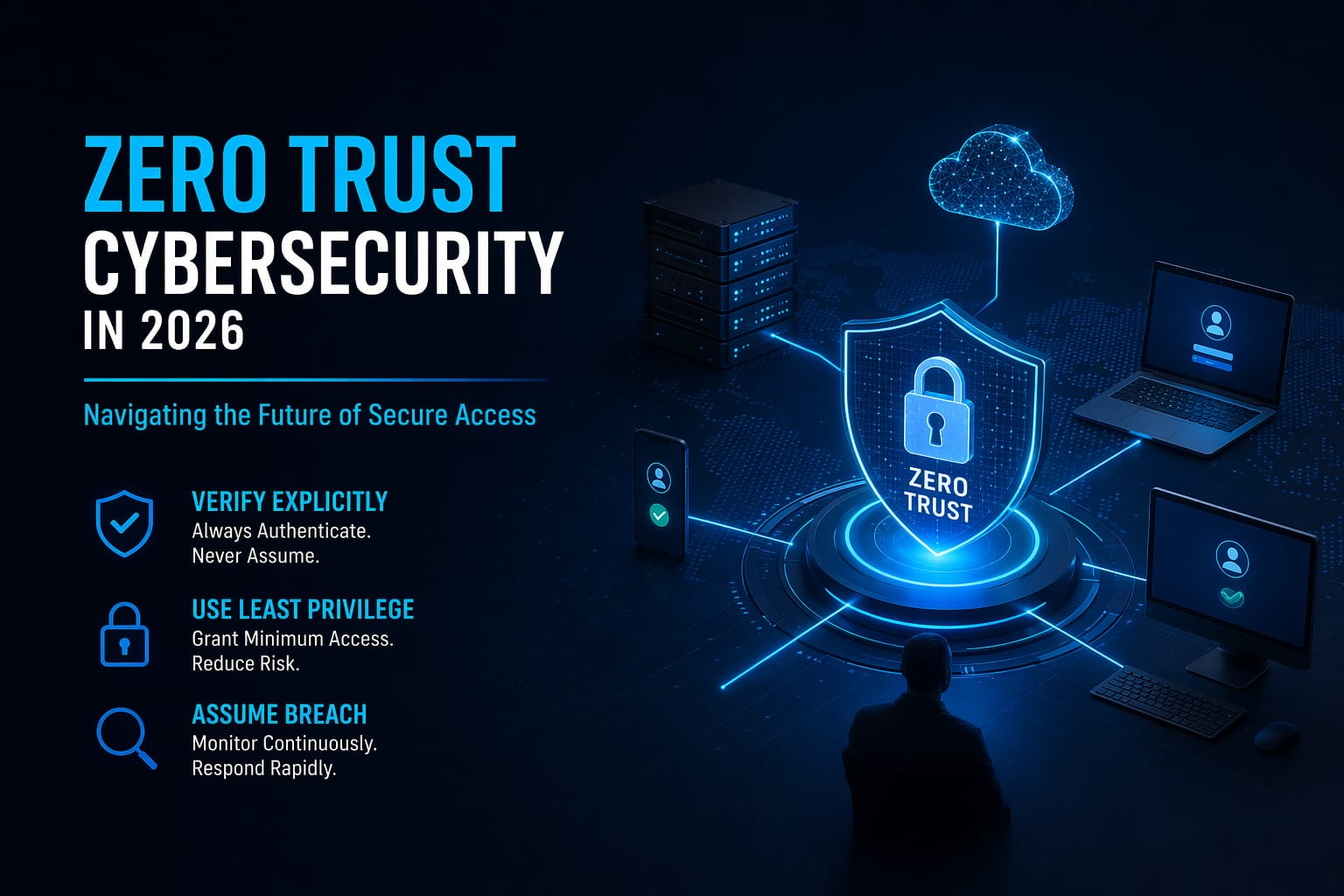
- Verify Explicitly: All resources are accessed securely regardless of location. All access requests are authenticated and authorized based on all available data points, including user identity, location, device health, service or workload, data classification, and
- Use Least Privileged Access: Grant users and devices only the minimum access privileges required to perform their This principle, often combined with Just-In-Time (JIT) and Just-Enough-Access (JEA) policies, significantly reduces the potential impact of a compromised account.
- Assume Breach: Design and implement security with the assumption that a breach is This involves segmenting networks, monitoring all traffic, and having robust incident response plans in place.
Zero Trust in 2026: Emerging Trends
As we move further into 2026, the Zero Trust landscape is evolving rapidly, driven by advancements in AI, the proliferation of IoT devices, and the need for more granular control.
Zero Trust for AI Agents
The increasing adoption of AI and autonomous agents introduces new security challenges. Applying Zero Trust principles to AI agents involves securing their identities, protecting sensitive data they process, and ensuring their actions are continuously monitored and authorized. This includes:
- Agent Identity and Access Management: Establishing strong authentication and authorization mechanisms for AI
- Data Protection: Implementing policies to protect data accessed and generated by AI agents, ensuring compliance and preventing
- Continuous Monitoring: Real-time monitoring of AI agent activities to detect anomalous behavior and potential threats.
Just-In-Time (JIT) and Just-Enough-Access (JEA)
JIT and JEA are becoming increasingly critical components of Zero Trust. JIT grants temporary access to resources only when needed, for a specific duration, while JEA ensures that users and devices have only the bare minimum permissions required for their current task. This dynamic approach to access control significantly reduces the window of opportunity for attackers.
Microsegmentation
Microsegmentation continues to be a cornerstone of Zero Trust architecture. By dividing networks into smaller, isolated segments, organizations can apply granular security policies to each segment, limiting lateral movement for attackers and containing breaches more effectively.
Implementing a Zero Trust Architecture: Best Practices
Adopting a Zero Trust model is a journey, not a destination. Here are some best practices for successful implementation:
- Define Your Protect Surface: Identify your most critical data, applications, assets, and services (DAAS). This forms the core of your Zero Trust strategy.
- Map Transaction Flows: Understand how users, applications, and devices interact with your protect This helps in defining granular access policies.
- Build a Zero Trust Policy: Develop policies based on identity, device, location, application, and data classification Implement JIT/JEA principles.
- Monitor and Analyze: Continuously monitor all network traffic and user activity for Leverage security analytics and threat intelligence to detect and respond to threats in real-time.
- Automate and Orchestrate: Automate security tasks and orchestrate responses to streamline operations and improve efficiency.
- Regularly Review and Adapt: The threat landscape is constantly changing. Regularly review and update your Zero Trust policies and architecture to stay ahead of emerging threats.
Conclusion
Zero Trust is no longer a futuristic concept; it is a present-day imperative for robust cybersecurity. By embracing the principles of “never trust, always verify,” organizations can build resilient defenses against evolving cyber threats, protect their critical assets, and ensure business continuity in 2026 and beyond. Implementing a Zero Trust architecture requires a strategic approach, continuous effort, and a commitment to adapting to the dynamic cybersecurity landscape. The investment, however, is well worth it, providing a foundation for secure digital operations in an increasingly interconnected world.